
Oil Is Over, Just Not Quite Yet: The Energy Transition
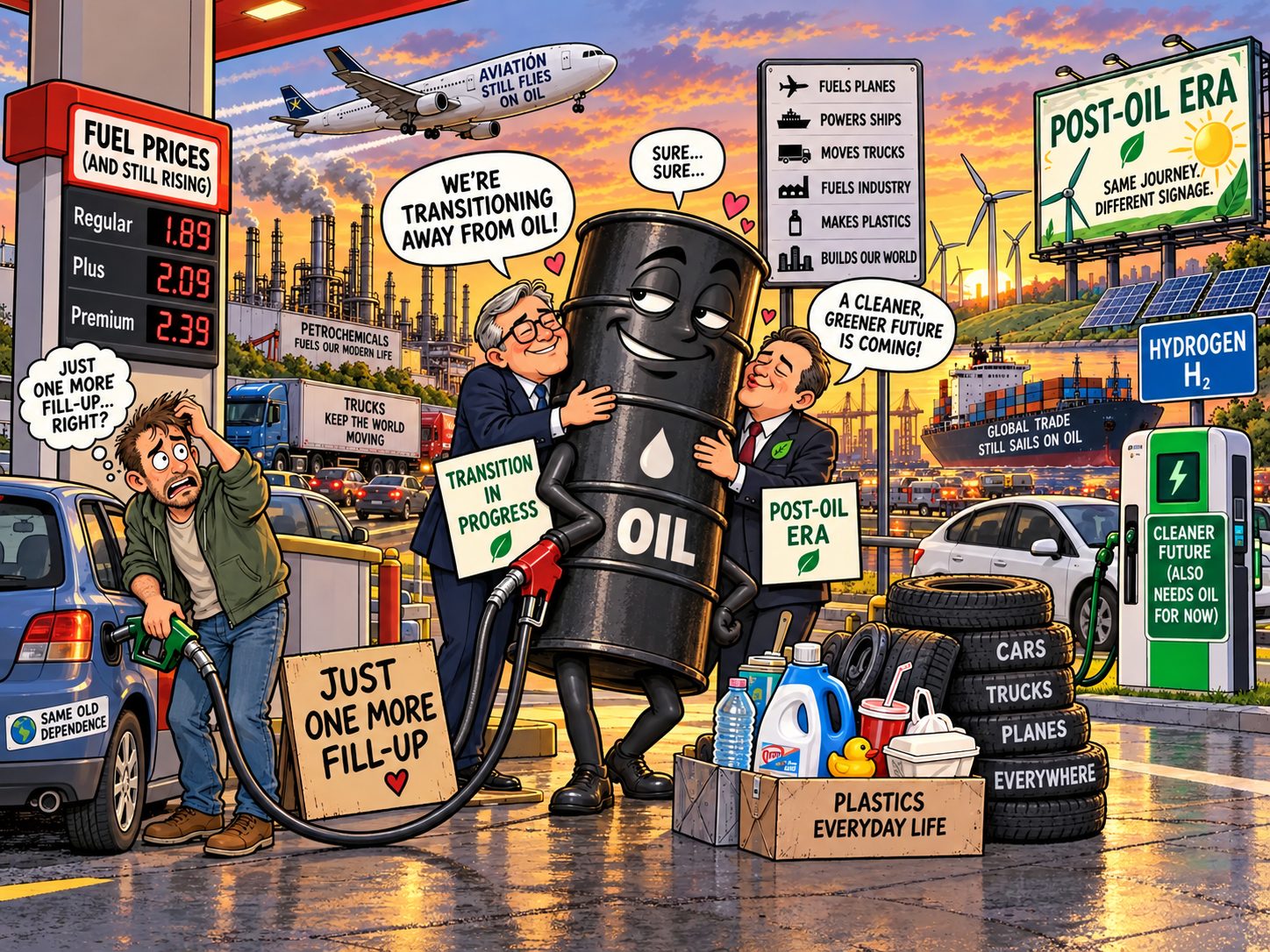
It is now a certainty: oil belongs to the past. Electric cars, renewable energy, hydrogen, public transport… governments and industries around the world are preparing for the post-oil era.
Oil has therefore received a very clear message: “It’s over between us. But stay a little longer.”
A complicated relationship that has already lasted for decades. Governments insist they want to reduce their dependence on fossil fuels while monitoring the price of a barrel with the concentration of a cardiologist staring at an electrocardiogram.
Because oil has one major flaw: it pollutes.
But it also has one quality modern economies greatly appreciate: it is involved in almost everything they do.
The Barrel, the Official Unit of Global Anxiety
Few products receive so much attention.
When the price of potatoes rises by 4%, no head of state calls an emergency meeting.
When oil moves sharply, however, economists, ministers, traders and journalists immediately start speaking faster.
Every movement comes with an explanation.
If oil rises:
“Markets fear supply disruptions.”
If it falls:
“Markets fear weakening demand.”
And if it does nothing:
“Markets remain cautious amid ongoing uncertainty.”
It is therefore theoretically impossible for the oil market to have a good day.
An Energy Source Nobody Wants but Everybody Buys
Oil now occupies a unique position in the global economy.
Officially, almost everyone wants to consume less of it.
In practice, nobody wants to be the first to run out.
Governments are therefore simultaneously trying to:
reduce oil consumption;
secure more oil;
build larger reserves;
prevent certain countries from selling oil;
ask other countries to produce more;
and then explain that we need to move away from oil.
An energy strategy scientifically known as:
“We’ll see what happens.”
The Electric Car Was Supposed to Solve the Problem
The rise of electric vehicles was supposed to mark the beginning of the end.
Oil took note and quietly moved into aircraft, cargo ships, trucks, petrochemicals, plastics, fertilisers, industrial machinery and everything else that had not received the memo.
A fictional oil representative remains philosophical:
“If you no longer need us to drive to the bakery, we respect your decision. We will simply remain present in the road, the tyres, some of the plastics in your car and part of the supply chain that produced it.”
He reportedly then asked where to send the invoice.
Environmentalism, but With a Reasonably Priced Barrel
Western governments continue to insist that the energy transition must accelerate.
But with one important qualification.
Oil needs to become unnecessary.
Not expensive.
Because expensive oil has the remarkable ability to turn a debate about climate policy into a debate about household purchasing power almost instantly.
At 8 a.m.:
“We must accelerate our transition away from fossil fuels.”
At 11 a.m.:
“Rising fuel prices are concerning.”
At 3 p.m.:
“We are calling on producers to stabilise the market.”
At 6 p.m.:
“The green transition remains our absolute priority.”
Then the minister goes home.
Traders Remain Confident
In trading rooms, the energy transition is being followed very closely.
Traders know oil may eventually lose a significant part of its role in the global economy.
The only question is when.
2030?
2040?
2050?
Nobody knows precisely.
Which still leaves plenty of time to buy on Monday, sell on Tuesday and explain on Wednesday that nobody could possibly have predicted what happened.
A Solution Has Finally Been Found
After international summits, climate conferences, ministerial meetings and thousands of pages of reports, a global compromise appears to be taking shape.
Humanity is going to move away from oil.
Consumer countries will reduce their dependence.
Producer countries will diversify their economies.
Car manufacturers will electrify their vehicles.
Oil companies will invest in new forms of energy.
And everyone agrees that it is time to begin.
Right after the next fill-up.
The facts are serious. We are considerably less so.
This article is satirical. Any quotations attributed to fictional representatives, experts or other fictional figures are invented for humorous purposes.